
Land Studio Director and Landscape Architect Simon Richards discusses the importance and benefits of a 'whole park approach'.
Holiday and residential parks in the UK are experiencing steadily rising expectations. Since early 2024, new legislation on biodiversity and drainage has made environmental performance a core part of park design and operation, rather than an optional extra.
My colleague Lisa Sawyer and I recently presented this “whole park approach” to the Holiday and Residential Parks Association (HARPA) Clwyd AGM, reflecting the growing interest from park owners and operators in more integrated, future‑proofed design.
In England, Biodiversity Net Gain (BNG) now requires most new developments to deliver at least a 10% measurable uplift in biodiversity compared to the existing baseline.
In Wales, the Net Benefit for Biodiversity duty and the requirement for Green Infrastructure Statements push schemes to show clear ecological enhancements.
Alongside this, both nations have tightened controls on surface water and foul drainage – through Sustainable Drainage Approval Boards (SAB) in Wales, national SuDS standards in England, and stricter Environment Agency / Natural Resources Wales and water company discharge criteria.
Against a backdrop of dramatic biodiversity decline and increasing public concern about sewage discharges to rivers and coasts, piecemeal, bolt‑on solutions at the end of a design process are no longer enough.
A whole site (or “whole park”) approach recognises that ecology, drainage, layout and guest experience are all connected. Instead of designing the lodge or caravan layout first and then trying to “fit in” habitats and ponds around the edges, the process starts with a robust baseline:
- Baseline survey – understanding the site’s existing ecology, drainage patterns, landscape character, levels and services.
- Integrated concept design – using that information to shape the masterplan from day one, rather than treating it as a constraint to be worked around.
- Testing and coordination – refining the layout so that biodiversity, drainage, access, views and operations all work together.
- Consenting and delivery – presenting a coherent story to planners and regulators, then delivering what’s been promised on the ground.
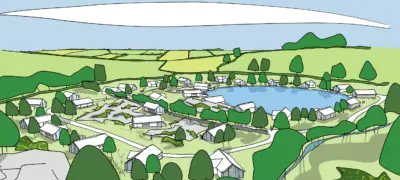
Our involvement in the design of a proposed lodge park at Aqueduct Marina in Cheshire illustrates the benefits of this approach.
The site comprises semi‑improved pasture, boundary hedgerows, mature oaks and scrub. Baseline ecological work showed that the semi‑improved pasture was of relatively lower ecological value than the surrounding habitats. This allowed development to be focused on the pasture, while retaining and enhancing the higher value features such as hedgerows, mature trees and scrub.
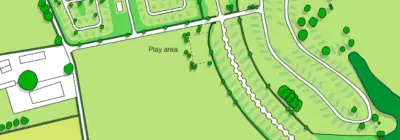
At the same time, the team analysed levels, drainage routes, views across the Weaver Valley and the relationship to the existing marina and workshops. This led to a concept based on small pockets of lodges nestled within a naturalistic landscape, with views over new and existing waterbodies and the wider countryside.
Surface water management is delivered through integrated SuDS – lakes and swales providing both attenuation and attractive focal points, supported by permeable surfacing. Foul drainage is handled by a separate treatment system, designed to meet regulatory standards and protect local water quality.
Crucially, habitat retention and creation are not afterthoughts. Existing hedgerows, trees and scrub are kept wherever possible, with new ponds, grassland and planting woven through the lodge layout. This delivers the required 10% BNG while creating a more secluded, high‑quality visitor experience and a simplified, more natural maintenance regime.
For park operators, this whole site approach offers clear commercial advantages: smoother planning, reduced risk of redesign to meet BNG, lower long‑term drainage and maintenance costs, and a more distinctive, nature‑rich product that meets growing guest expectations.
In a market where environmental performance and place quality are now central to success, designing the entire park – from biodiversity to drainage – as one integrated system is how future‑ready parks will be planned, consented and enjoyed.
Designing an entire park – from biodiversity to drainage – as one integrated system is how future‑ready parks will be planned, consented and enjoyed.
Simon Richards