
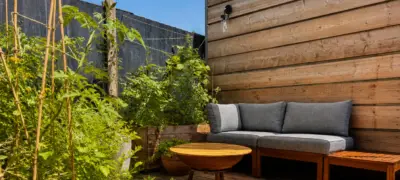
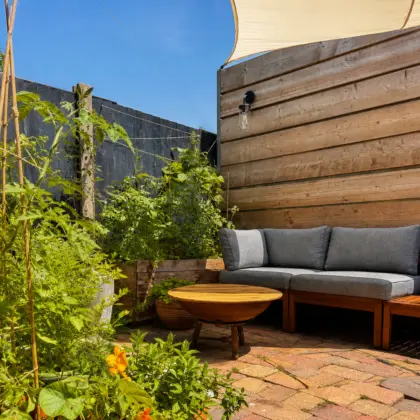
It is easy to look at a small paved yard and see only its limits. Matt Northall, a landscape architect at Land Studio says his garden is barely 3x3m, hemmed in by brick walls, fencing, bins, paving and pipes but over the past few months, it has become something far more hopeful: a tiny garden full of shade, scent, bees, edible leaves, flowers, water and family life.
As a landscape architect, Matt has spent a lot of time thinking about green infrastructure, planting strategies, water management and material reuse at a much larger scale. His garden though has been a reminder that the same principles can start at home, quietly, with one paving slab lifted and a bit of imagination.
The transformation began with the simplest move: lifting selected block pavers. Beneath them was the expected compacted hardcore, which was excavated back to subsoil and replaced with compost and topsoil. Retained concrete blocks were pinned to prevent movement, allowing small planting pockets to be created without rebuilding the whole space. It was a modest intervention, but it changed how the yard behaves. What was once a hard, hot surface can now absorb water, support roots, cool the paving and soften the edges of the house.
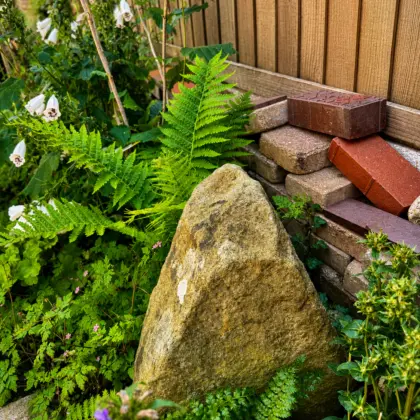
Nothing has been treated as waste. Lifted paving blocks have been reused as a small bug hotel and habitat pile, giving insects cool crevices and shelter. Left over scaffold boards and closed-board pallet tops have become raised planters, creating soil depth for herbs, vegetables, climbers and young trees. The garden has become a tiny circular economy, full of practical reuse and quiet resourcefulness.
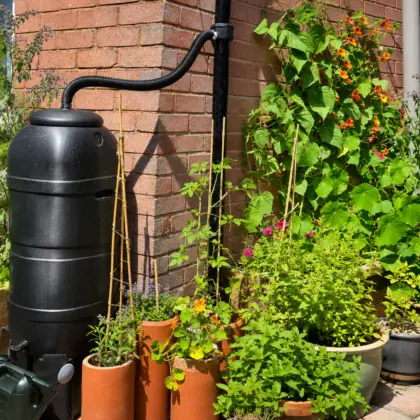
Water is one of the small heroes of the space. A water butt collects rain from the roof, reducing reliance on mains water and making the garden feel more connected to the weather. The new planting pockets slow surface runoff, while compost-rich soils hold moisture for longer. Even the shade sail plays its part, cooling the yard, reducing evaporation and turning an exposed corner into a comfortable family space. It gives the garden a ceiling, a softness and a sense of retreat.
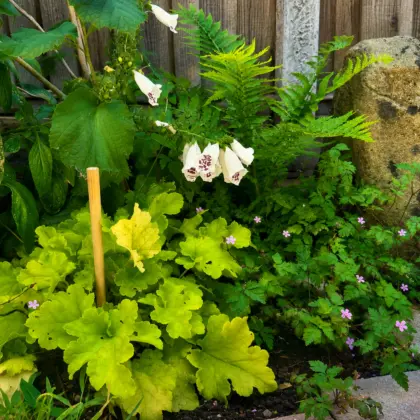
The planting is native-led, some edible and pollinator-friendly species, chosen to work hard in a small area. In the shadier pockets, foxgloves, Digitalis purpurea, ferns such as Dryopteris, and woodland-style groundcover create a soft understorey character. Elder, Sambucus nigra, hawthorn, Crataegus monogyna, and hazel, Corylus avellana ‘Webb’s Prize Cob’, bring a hedgerow quality into the yard, offering blossom, berries, nuts and habitat value. A greengage, Prunus domestica ‘Oullins Golden Gage’, adds a productive orchard note.
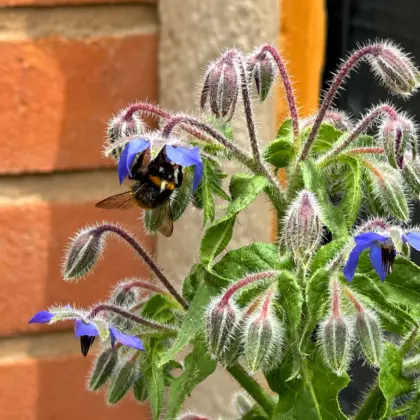
Borage, Borago officinalis, has become a brilliant pollinator magnet, with bees constantly visiting its blue flowers. Nasturtiums, Tropaeolum majus, scramble through the warmer brickwork with edible leaves and fiery flowers, while mint, Mentha, herbs, beans and tomatoes add scent, food and movement.
What has been most inspiring is how quickly life has arrived. Bees move through the borage. Ferns unfurl around stone and reclaimed brick. Climbers stitch the walls together. Leaves spill over the planters. The garden now has layers of food, nectar, shelter, shade, water and somewhere to sit with a cup of tea and watch it all unfold.
A 3x3m yard will never be a meadow, woodland or wetland, but it can borrow something from each of them. Sometimes nature does not need grand gestures. Sometimes it just needs one paving slab lifted, one plant given room, and one person willing to begin.

We were really impressed with Land Studio. They are creative, a delight to work with and captured our vision and their own vision perfectly.
Shahina Ahmad, Principal of Eden Girls’ School, Waltham Forest.