
Is Planting Culture the Key to Resilient Landscapes?
The past few months have shown how quickly our landscapes can shift under pressure. As Simon notes, “spring gave way to summer, and autumn is nearly upon us, leaf drop from our trees has been dramatic.” These rapid transitions are no longer anomalies - they are becoming the new normal.
The End of the Traditional Garden
For decades, the British garden has been defined by a manicured lawn contained by a border of annuals and shrubs, an aesthetic built on regular rainfall, predictable seasons, and intensive maintenance. That model is increasingly unsustainable. Lawns demand water and labour; bedding plants offer little ecological value and struggle in prolonged dry spells. As conditions become more extreme, this familiar template delivers diminishing returns.
Climate resilience isn’t just a technical challenge for large public landscapes. It begins in domestic gardens, where cultural expectations are strongest and where many people form their understanding of what “good” planting looks like. If we want resilient landscapes at scale, we need to shift the norms that shape everyday design decisions. That shift doesn’t mean simply swapping one familiar model for another; it requires a more nuanced rethink of the alternatives we often reach for.
Meadows: Brilliant, But Not a Universal Answer
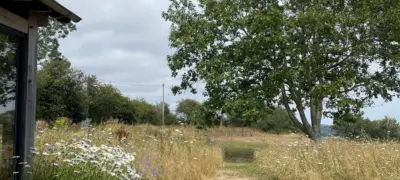
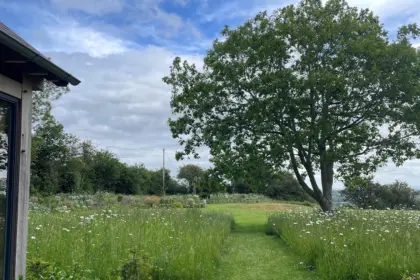
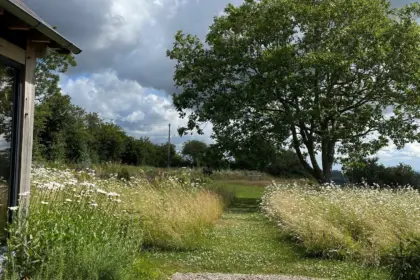
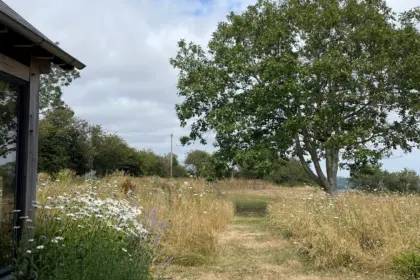
Meadows have become a go‑to symbol of ecological design, rich in biodiversity, low in inputs, and visually appealing at their peak. But how do they fare in longer periods of drought? The answer is: not always well.
In extended dry spells, meadows can brown early, lose structure, and appear “dead” in contexts where people expect green. They are not always suitable for small gardens, shaded sites, or high-footfall urban spaces. Meadows remain a powerful tool, but they are not a one-size-fits-all solution. Resilience requires choosing the right habitat for the right place, not defaulting to a single ecological aesthetic.
Dry Gardens, and the Power of Mulch
Designing for drought does not mean designing for scarcity. Dry gardens show how resilient planting can be rich, textural, and full of seasonal interest. These schemes rely on species adapted to heat and low moisture, offering beauty without irrigation.
Mulching is an equally important, often overlooked tool. Organic mulches protect soil structure, reduce evaporation, and improve fertility over time, while mineral mulches support dry garden aesthetics and suppress weeds. Mulch should be treated as a design decision, not an afterthought: it is one of the simplest ways to build resilience into planting from day one.
Resilience Is Cultural as Much as Technical
As Simon writes, “the shift we're describing isn't one change, it's a connected way of thinking about landscape, water, and planting together.” To complement that systems approach, we must also shift expectations, moving away from landscapes that look perfect on day one and towards landscapes that perform over decades.
Resilient landscapes are not just technical systems; they are cultural choices. The sooner we adapt our planting culture, the better prepared our gardens, parks, and public spaces will be for the climate ahead.

We were really impressed with Land Studio. They are creative, a delight to work with and captured our vision and their own vision perfectly.
Shahina Ahmad, Principal of Eden Girls’ School, Waltham Forest.