
Plants, Soil, Water: Designing Resilient Landscapes for a New Climate
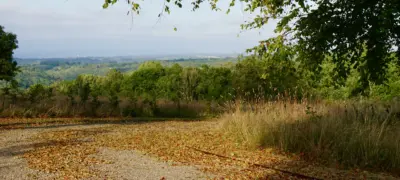
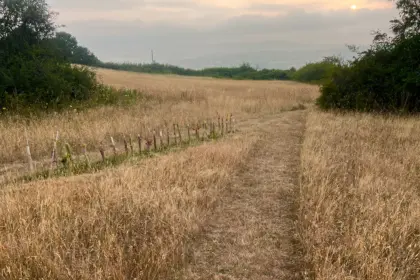
It has been an incredibly dry 6 weeks. The last significant rainfall across North Wales and the North West fell on 11th June, and since then our landscapes have raced through entire seasons. Spring gave way to summer, and autumn is nearly upon us, leaf drop from our trees has been dramatic, and species that would normally flower in August have already bloomed and faded.
It's not just something we're seeing on other isolated projects, either. We have mature Beech trees in our own garden under real stress and already dropping their leaves, months early. Over 100m of hedging we planted last autumn needs drip irrigation every couple of days. This isn't a hypothetical scenario for the future, or one confined to commercial schemes - it's happening now, in our own gardens as much as in the landscapes we design for clients.
We've enjoyed the warm, sunny weather, but there's a larger implication casting a shadow over it that, as a society, we haven't really addressed. How far will this go? If we're seeing 35°C summers now, what does that look like in five or ten years? What is this doing to the long-term health of our landscapes, both new and mature? And how should we, as professionals in the built environment, be approaching the design and management of our landscapes to respond?
The traditional approach to planting has long been to procure, plant, and walk away: aftercare is seen as an afterthought with plants largely expected to fend for themselves. That model maintained an equilibrium when a reasonably stable climate did the rest of the job for us - it can no longer be relied upon in the same way. It also raises a specific question: is our current list of plant species still the right default in a climate swinging this widely between heat, drought, and heavy rainfall? Native planting has long been the sustainable, ecologically sound choice, and rightly so, but resilience to our historic climate doesn't automatically mean resilience to the one we're heading into. The answer isn't simply a different species list, it's recognising that planting can no longer be designed in isolation and left to look after itself.
Designing a resilient system
No single measure will see our landscapes through this. What's needed is a resilient system, where each part supports the next: water retention feeding irrigation, resilient species suited to increasingly irregular weather, and healthy soils underpinning successful plant establishment and maintenance. Treated in isolation, these ideas are just good practice. Connected, they become a system that can have the resilience to absorb both drought and downpour:
- Healthy soils underpin everything else, from water retention to root establishment, and are often the first thing to suffer under prolonged drought. Understanding the type, quality and depth of soils on site is essential. Protecting and improving soil structure is where resilience starts.
- Resilient species, chosen for strong rooting and drought tolerance across both structural and ornamental planting, cope with the swings between heat, drought, and heavy rainfall that a single-species or purely native palette may not.
- Integrated SuDS drainage, designed for increasingly intense storm events rather than historic averages, captures the rainfall that does fall rather than losing it to run-off.
- "Winter water" storage, in waterbodies or storage tanks, closes the loop by holding that captured rainfall through to summer, when it's needed most for irrigation.
Each element depends on the others. Drought-tolerant planting still needs healthy soil to root into; storage tanks are only useful if the drainage feeds them; and irrigation only buys time if the underlying soil and species can make use of it. The shift we're describing isn't one change, it's a connected way of thinking about landscape, water, and planting together.
For our clients, this matters well beyond aesthetics. A landscape that fails within a few years of planting, or a SuDS scheme that can't cope with an intense storm, creates real cost and risk. Building resilience in at the design stage is far cheaper than repairing a scheme once it has failed.
We don't have all the answers yet, and neither does the wider industry. But we think these are the right questions to be asking now, while there's still time to build resilience in rather than retrofit it later. As ever, we'd love to hear how you're thinking about this on your own projects.
We were really impressed with Land Studio. They are creative, a delight to work with and captured our vision and their own vision perfectly.
Shahina Ahmad, Principal of Eden Girls’ School, Waltham Forest.