
A proposed residential development in the North West of England has become one of our ecology team's most rewarding projects this year, not because the site was unusual, but because of how much it had to say once we looked properly.
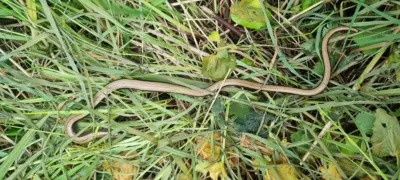
At first glance, it looked straightforward: silage grassland, bordered by hedgerows and mature trees, the kind of site that often raises few ecological flags. But the Preliminary Ecological Appraisal told a different story. The site sat alongside a tree- and scrub-lined railway embankment, with a ditch along the southern boundary feeding into a wider network of hedgerow connectivity. During the initial survey, a grass snake was found in the grassland. Badger setts turned up along the embankment. A desk study flagged otter records in the wider area, putting the southern ditch in a new light as a likely commuting route. What looked like an unremarkable field was, in fact, a site stitched into the wildlife movements of the wider landscape.
Further surveys, including reptile and badger surveys, a Ground Level Tree Assessment, and a Biodiversity Net Gain assessment, confirmed slow-worm alongside grass snake, and active badger setts tied to the railway corridor. The temptation, at this point, is to treat these findings as a list of constraints to be managed around. We see it differently. These findings are information the design can respond to, and that's where it gets interesting.
This is really the heart of what we do. Ecologists are often seen as the people who tell you what you can't do with a site. We'd rather be the people who help shape what you can. Understanding a badger sett's location, or how grass snakes move through scrub, isn't just survey data, it's a description of how a site already works, and that description can inform a layout just as much as topography or access constraints do. While we delivered the ecology work on this site, our wider studio works this way as a matter of course; our ecologists, landscape architects and drainage engineers think alongside each other, and that habit of thinking in terms of design, not just constraint, comes through in how we approach every ecology brief, including this one.
In practice, that meant working closely with the client and design team to revise the layout around what the site was telling us. Rear gardens were positioned against the railway embankment, keeping housing at a sensible distance from the badger setts. Grassland near the site entrance was retained to protect a main sett. A buffer was built in alongside the southern ditch, protecting the wildlife corridor while opening up space for habitat enhancement. None of this was about scaling back the scheme. It was about finding the layout that let housing and habitat sit alongside each other properly.
The result speaks for itself: protected species avoided, ecological connectivity around the boundaries retained and strengthened, and a series of real enhancements built in, including wildflower planting, additional tree planting, and deadwood hibernacula for reptiles. The scheme achieved a Biodiversity Net Gain of over 10 per cent, while still delivering the housing the client needed.
That, ultimately, is what good ecological input looks like: not a checklist applied after the fact, but a way of reading a site that helps shape a better design for it. Ecologists are, in a sense, designers too, designers for nature, and for the people who'll go on to live alongside it. Get that input early enough, and it stops being a hurdle and starts being one of the most useful tools a project has.
We were really impressed with Land Studio. They are creative, a delight to work with and captured our vision and their own vision perfectly.
Shahina Ahmad, Principal of Eden Girls’ School, Waltham Forest.