
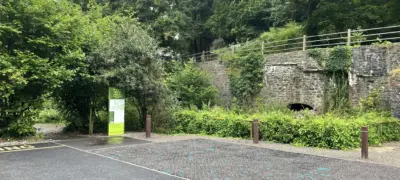
Lower Wireworks Car Park, on the banks of the River Angidy (a tributary of the Wye), serves as a key gateway to Tintern Abbey and the village of Tintern, in south-east Wales.
Monmouthshire County Council (MCC) secured Welsh Government Brilliant Basics funding through the ‘Tintern Welcome’ project to strengthen arrival and improve the visitor experience. This commission addressed peak-time parking pressure by upgrading the existing stone-dust surface with a SuDS-compliant solution that enabled clear bay marking and circulation, increased usable capacity to around 42 spaces, and provided dedicated accessible bays, while allowing for future smart parking and EV infrastructure.
The site had suffered from informal parking beyond usable areas, poorly defined spaces and failing boundary elements; the design responded with durable, low-maintenance detailing and environmentally sensitive surfacing.
As lead consultant and Principal Designer, Land Studio delivered the design and supported implementation. We scoped required investigations and surveys, coordinated utilities information (including future EV/ticketing considerations), and advised on planning, environmental and heritage requirements. We produced a tender-ready package of updated layout drawings, specifications and construction details, plus supporting schedules, and then provided contract supervision on site, including overseeing the archaeological watching brief undertaken by Dr Phillips of APAC.
Working in Tintern had meant operating within an unusually concentrated heritage landscape, where visitor infrastructure sat alongside nationally important archaeology and a highly valued river valley setting. The car park lay within the setting of the Abbey and the industrial landscape, so the design followed a deliberately light-touch approach that improved legibility and accessibility without competing with the place’s historic character.
Design decisions were shaped by the site’s statutory context: the Lower Wireworks, Tintern Scheduled Monument, proximity to Tintern Abbey (Scheduled Monument and Grade I listed Abbey Church of St Mary and monastic buildings), the Tintern Conservation Area, the Wye Valley National Landscape, and the ecological sensitivity of the River Wye SAC. These designations reinforced the need to minimise ground disturbance and keep interventions visually recessive. A SuDS-led surfacing strategy reduced the need for deep excavation while enabling clear bay definition, and we retained existing boundaries where possible, supplementing them with new bollards to protect the Scheduled Monument within the site, and an estate-rail-style fence along the river bank to support safety, manage access and help protect sensitive river-edge ecology without interrupting key views.
Overall, the project had shown how ‘everyday’ infrastructure could contribute to stewardship: by making capacity and accessible provision explicit, it reduced pressure for informal parking elsewhere in the village and supported a calmer, more coherent arrival experience. Future adaptability (such as smart sensors or EV charging) had been considered as enabling potential rather than a visual driver, ensuring the scheme remained focused on refining the ground plane and respecting Tintern’s exceptional heritage setting.

We were really impressed with Land Studio. They are creative, a delight to work with and captured our vision and their own vision perfectly.
Shahina Ahmad, Principal of Eden Girls’ School, Waltham Forest.