
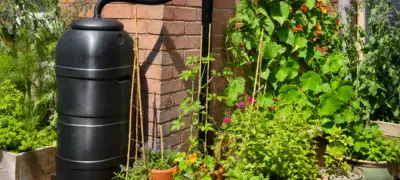
Households and businesses across the UK are under growing pressure to use mains water more efficiently and for those on a water meter reducing water consumption will help save money on bills. There are many water efficiencies seen within sanitary wear, but what is often not talked about is the collection and reuse of rainwater external to our properties.
New research from the Royal Horticultural Society (RHS) nationwide study, “Helping Homes Save Water Outdoors”, using smart meters and flow tracking the RHS are trying to understand exactly how much mains water households use outside for landscape irrigation and where the biggest opportunities for savings can lie.
With climate change and population growth increasing pressure on water supplies, identifying practical, everyday actions that can reduce demand from households while still supporting healthy, thriving gardens are key to the outcome of the RHS study.
💧 The Simple Water Butt
A simple water butt captures rainwater from the roof and stores it for later use. This is then typically used for watering plants, topping up wildlife ponds, or washing down hard areas such as patios and driveways. The storing of water can reduce the reliance on treated mains water, which is energy intensive to produce and increasingly vulnerable to drought restrictions.
Water butts not only reduce pressure on the local water supply but also
- Reduce surface water being drained into the public sewer networks which reduces the increased use of combined sewer overflows into our rivers
- Reduces flooding due to overloading of underground drainage systems, especially during summer storms which are often more intense than winter events
- Supports wildlife and habitats by providing chlorine free water to landscaping and ponds
Smart water butts can now be found on the market which connect to local Wi-Fi networks. They use predictive AI algorithms to scan local weather forecasts. If a heavy rainstorm is 12 hours away, the tank autonomously triggers a low-level motorized valve, releasing just enough stored water into your garden or a soakaway to create exact capacity for the incoming storm.
📊 How much water can one water butt save?
For a typical 3 bed semidetached home in the UK, the numbers are surprisingly powerful. Based on an average roof area of 20-30m2 and average UK rainfall of 800mm/year (although this is becoming increasingly more) a 200l water butt connected to one downpipe can collect: ≈ 21,000 litres of rainwater per year. That’s equivalent to 330 standard mixer showers, or 6–8 months of watering a standard garden. If the household is in a metered area then this could save around £60 per year in avoided water charges.
🏠 Incentives
Incentives to install water butts for the regular householder are different across the UK but currently the following water companies are offering incentives.
- As part of a £450m investment to improve river quality Severn Trent are currently installing water butts in certain postcode areas https://www.stwater.co.uk/wonderful-on-tap/save-water/water-butts-checker/
- Dwr Cymru/Welsh Water will provide a rebate for domestic and small commercial properties where all surface water has been removed from the public sewer system and water butts can be a part of this design solution. https://www.dwrcymru.com/en/help-advice/surface-water-rebate
- United Utilities are trialling a number of ways to reduce water from households including giving customer reductions on water bills dependant on the number of interventions which are being installed, which can include water butts but also permeable driveways. https://www.unitedutilities.com/help-and-support/wastewater-services/rainwater-management/RainwaterManagementTermsandConditions/
- Thames Water have partnered with Greenredeem to reward households for saving water. https://www.thameswater.co.uk/help/water-saving
Whilst there are no specific requirements for single householders to save water the government overhauled the National Standards for Sustainable Drainage Systems (SuDS) for the design of any new build developments in England. For the first time, rainwater harvesting has been legally designated as the highest-priority, frontline method for controlling surface water runoff. This change forces developers to build rain capture systems into their site layouts to secure planning approvals, rather than relying on underground storage systems. Part of this solution can be to include water butts. Whilst this standard is not yet mandatory we are seeing many local planning authorities quoting this standard when setting planning conditions on schemes.
Maybe just as saving energy and using green energy techniques has been written into planning policy we will see water saving and water reuse have the same requirements especially on new build properties.

We were really impressed with Land Studio. They are creative, a delight to work with and captured our vision and their own vision perfectly.
Shahina Ahmad, Principal of Eden Girls’ School, Waltham Forest.