
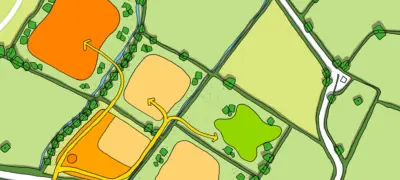
Across Wales, the pressure on land is intensifying. Competing demands for housing, transport, energy, climate adaptation, and biodiversity restoration requires a more coordinated and strategic approach to how land is planned and managed.
A Green Infrastructure Statement (GIS) provides a vital opportunity to embed nature, resilience, and wellbeing at the heart of decision-making.
Planning Policy Wales (PPW) Edition 12 (2004) requires that all planning applications in Wales must be accompanied by a GIS. This applies to all scales of development, from householder extensions to major schemes
The GIS must describe how green infrastructure has been incorporated into the design and be proportionate to the development’s size and complexity (simple for minor works, detailed for large schemes). All GIS submissions must demonstrate compliance with the “step-wise approach”, a strict decision-making hierarchy:
- Avoid impacts on existing green infrastructure
- Minimise impacts where avoidance is not possible
- Mitigate impacts on-site
- Compensate off-site but only as a last resort
GI Statements must align with Planning Policy Wales (PPW), Local Development Plans (LDPs), Area Statements (Natural Resources Wales) and Technical Advice Notes (e.g. TAN 5 – nature conservation). This ensures consistency across planning decisions and integration with climate, biodiversity, and placemaking strategies.
The planning system in Wales has fundamentally shifted toward a nature-positive, design-led approach. The introduction of mandatory Green Infrastructure Statements means that every development must actively protect, enhance, and integrate green infrastructure, biodiversity net benefit is now a non-negotiable expectation and early, strategic planning is essential to achieving permission.
In England, there is no equivalent GIS. Instead, the system is driven by mandatory Biodiversity Net Gain (BNG) under the Environment Act 2021 which requires developments to deliver a minimum 10% measurable uplift in biodiversity.
Both approaches aim to reverse biodiversity loss but they reflect different philosophies. Wales is pushing a whole-system, place-based model, while England emphasises consistency and measurable gains.
Where local authorities are forward thinking and not see the GI statement as a tick box exercise then it is clear to see where biodiversity, landscape and water integration has not been designed for. If a GIS is not produced early on in the design process or not coordinated with the landscape and SuDS design then it can lead to planning objections, time delays or redesign costs.
At Land Studio we have provided a number of Green Infrastructure Statements for planning applications across Wales, whether alongside the landscape, ecology and SuDS design or not. Those GI statements that are successful and have a meaningful impact are those that ensure green infrastructure is considered from the outset and not retrofitted to get through a tick box exercise.
Please get in touch if you want to discuss holistic green and blue infrastructure design or the production of a Green Infrastructure Statement for your planning application.
We were really impressed with Land Studio. They are creative, a delight to work with and captured our vision and their own vision perfectly.
Shahina Ahmad, Principal of Eden Girls’ School, Waltham Forest.